Understanding Constructivism
A revolutionary industrial approach to architecture
The Constructivist Movement in Russia evolved from the Russian Revolution in 1905, following the October Revolution of 1917, lasting till the 1930s. The period was emblematic of a proletarian uprising against the bourgeoisie and aristocrats. It is associated with the Modern movement and the works of Le Corbusier and Mies Van der Rohe in Europe and a post-industrial response through artistic, socialist and architectural disciplines. The movement represented 19th-century realism in combination with a socialist moral upliftment, manifesting in a socialist realism which reigned through all the arts.
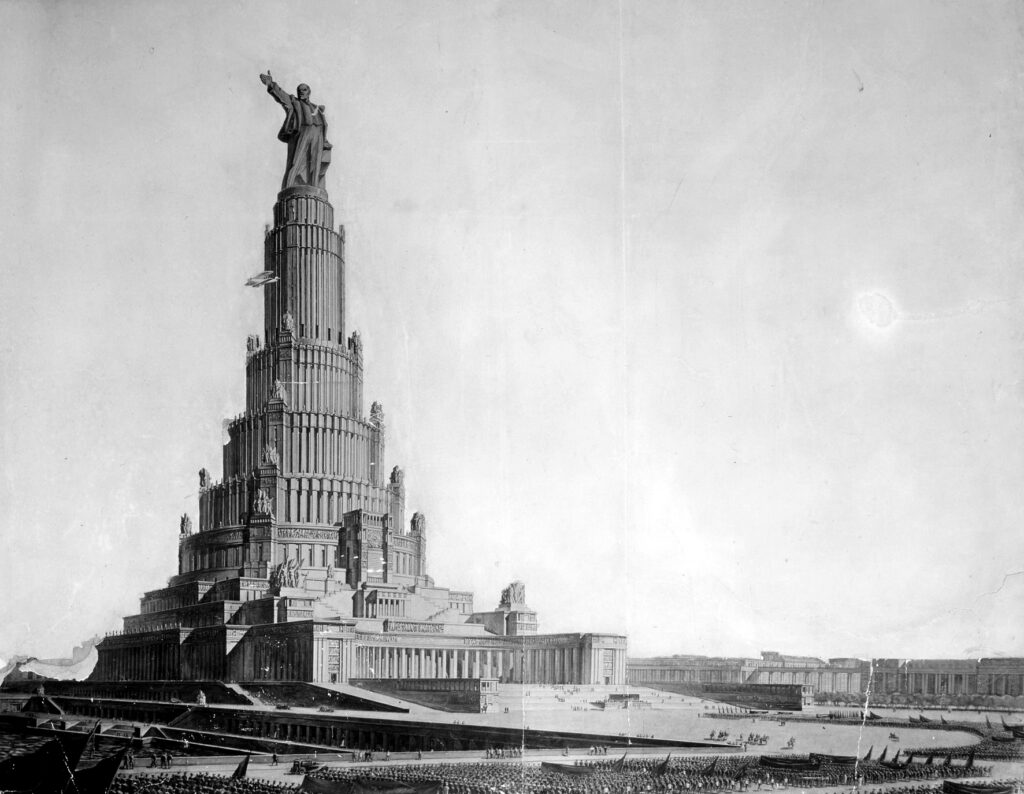
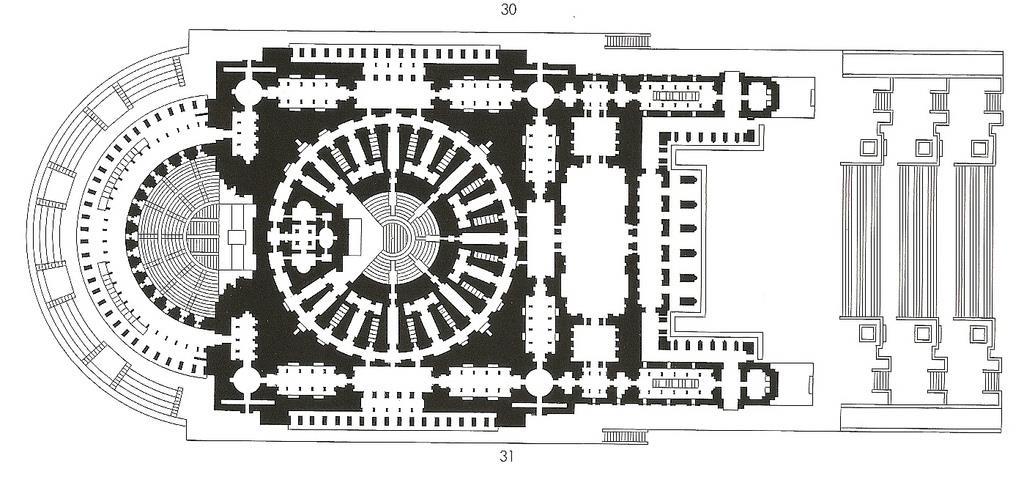
Palace of the Soviets, Boris Iofan, Vladimir Shchuko, Vladimir Helfreich
Constructivist architecture served as a political project used as propaganda by Stalin. Art was characterised by motion and chaos, while In architecture, the proletarian and socialist perspective was evident in the use of columns and the repetitive use of the diagonal. Moscow was designed to reflect socialist realism with grand columns and complex underground systems symbolising an efficient skeletal framework of city infrastructure. Here, the column represented a transference of power to the people and was extensively adopted in buildings reflecting nationalist sentiment and the social class of the artists and architects. The proliferation of this style of architecture across the Communist world was evident in the architecture of Bulgaria and China.
The use of the diagonal by the Bauhaus represents a constructivist aesthetic and its influence on Modernism. The diagonal created a new artistic expression with a constructivist aesthetic which represented a subversion of the bourgeois flat plane and aristocratic verticality. This approach to design is demonstrated through Tatlin’s Tower, a pivotal work by Vladimir Tatlin in the Constructivist architectural movement.
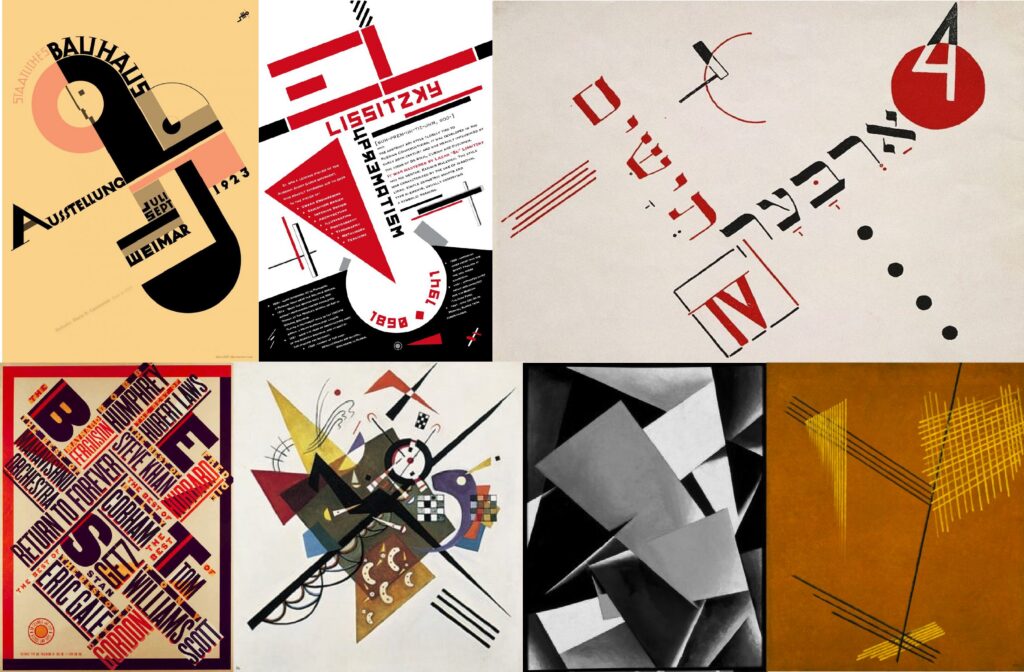
Employing the diagonal in the graphic language (Bauhaus and others)
Tatlin’s reliefs and counter-reliefs had been experimental and exploratory and, since 1914, had served as a precursor to the Tower Project. The works exhibited explorations in material, volume and construction, which aimed to produce new disciplines as rigorous as Classicism. Where the Classical language was constrained due to the structural limitation of marble, these new disciplines would be liberated by incorporating modern materials such as glass and iron.
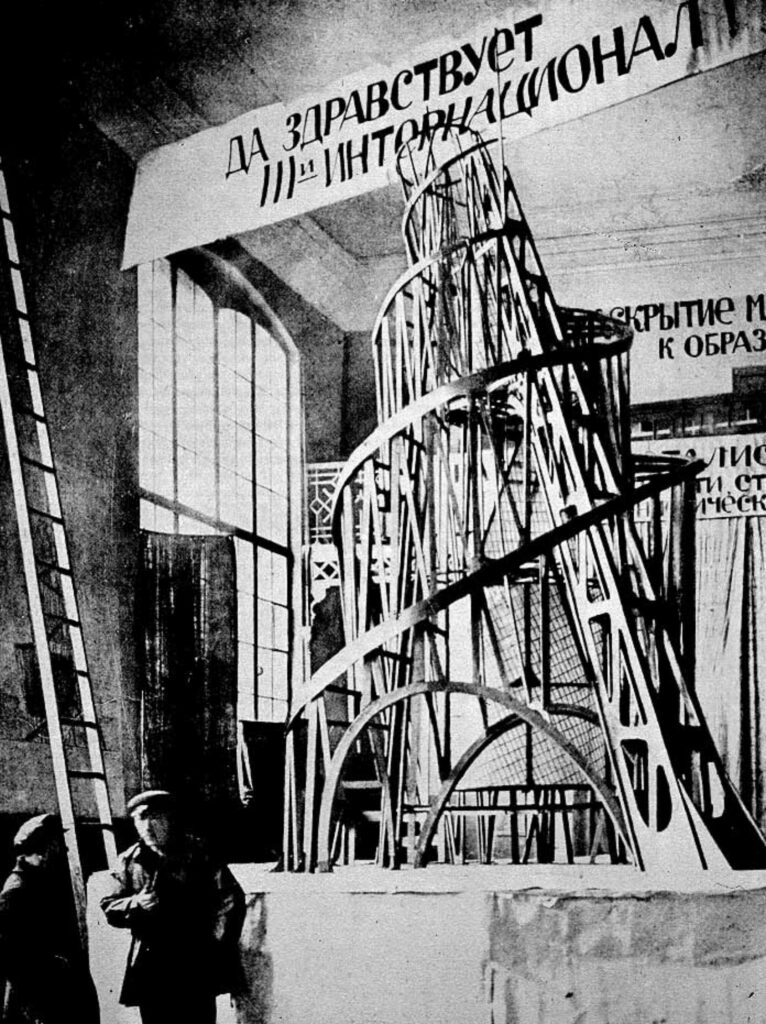
Taitlin’s Tower Maket (Model)
Constructivism is concerned with the creation of architecture that functions as a “social catalyst” that stimulates and influences society. This association has expanded the scope of its influence beyond the material object and built fabric of spiritual, metaphysical and socio-economic realities. Constructivists saw their role as influencers who were obliged to create a body of knowledge that, on the “sciences”, would assist in deriving alternate solutions or “nauki” in Russian in a materialist society.
Soviet terminology refers to the role of architecture as a social catalyst, literally as “social construction”, or the creation of a new social order. Constructivists have pursued the craft of formalism and sought to influence the design of an environment and world order surrounding this formal and spatial production. Their work critically engages with both social and building construction, addressing the multidimensional aspects of the architectural problem. By approaching the architectural discipline through a holistic understanding adopting a ‘systems’ approach, referred to in Russian as a “kompleksnyi” approach, the group sought to address the design of the built environment as an integrated matrix of relationships, forming distinct but associated parts of a whole.
Moisei Ginzburg illustrates the need to reassess and renew a fraction of the architectural product, or the built form in its entirety, in relation to a change in parameters that guide its creation. As Ginzburg explains, to assess the architect’s process or work method, constructivists employed experimental means through which clear distinctions are made between subsystems, isolating processes to create favourable conditions for its individual analysis. Constructivist architects were committed to generating “new classes of spatial organisms” or building typologies by studying objective and subjective properties. Ladovsky’s Rationalists worked as an organisation engaged in analysing and creating new architectural objects and types, effectively demonstrating the standards that defined their work process and product.
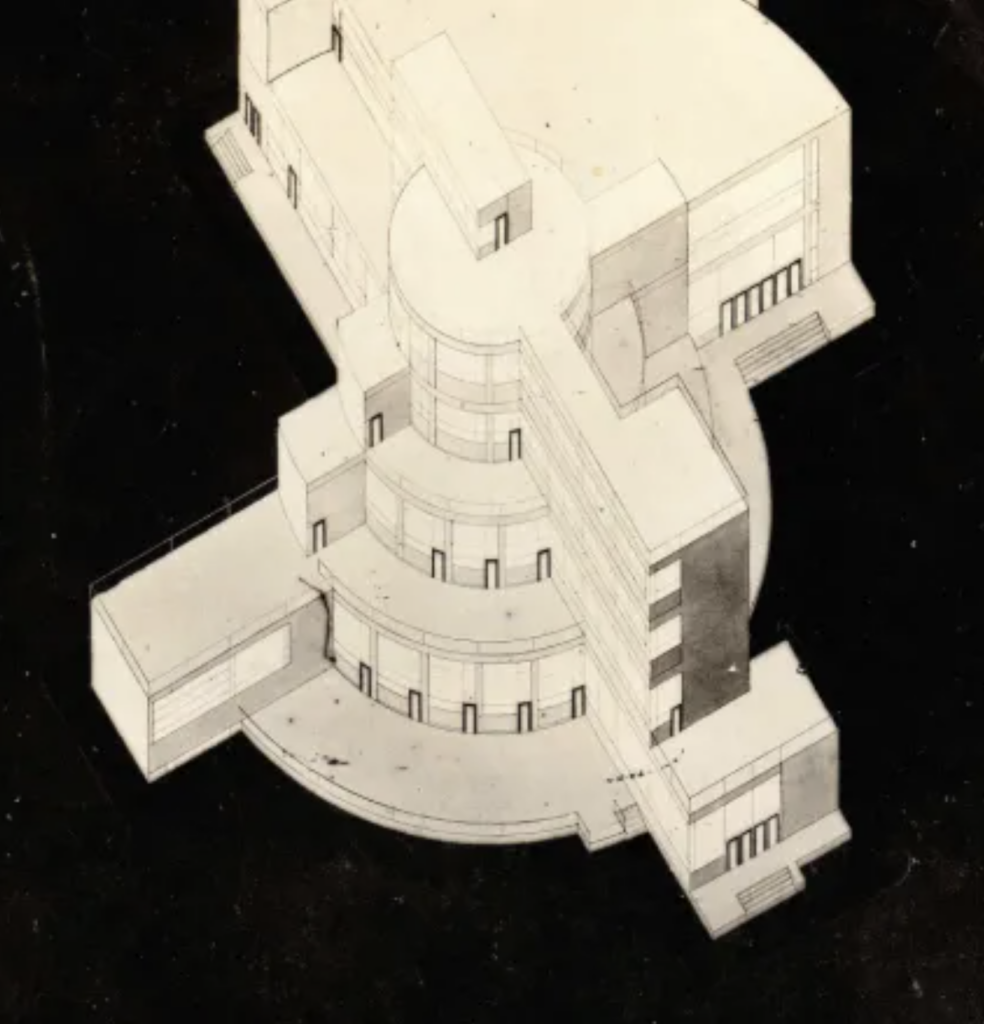
The Charnel House by Nikolai Ladovsky
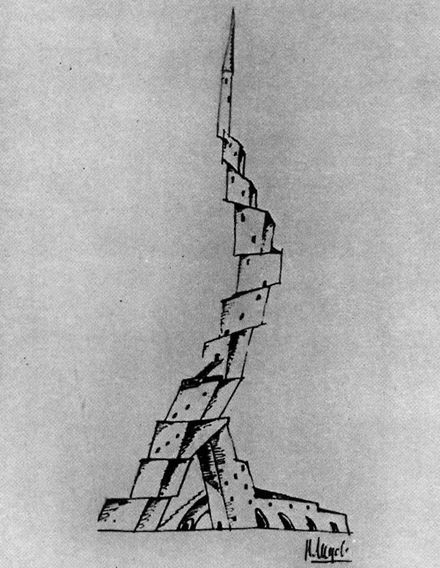
Ladovsky Sketch
Ginzburg’s ideas developed through his writings, emerging as a five-part schematic plan. He published his seminal work, “Style and Epoch”, in 1924, which served as a manifesto for constructive architecture. In 1925, the Constructivist group OSA was formed. The evolution and enrichment of the group’s ideology became evident through his writing and further articulated the group’s intention for themselves and their audience.
Ginzburg’s writings were concerned with
1. The catalytic role of architecture and the built environment in effecting social change – with building construction leading to social construction
2. The need for an organised method of working and the adoption of logical reasoning in design processes through which a designer may respond to create solutions based on logic and not mere intuition. 3. The range of factors required to be embraced by the method.
In a context governed by aesthetic standards, the Constructivists were passionate about creating poetics of architectural form in concrete through mechanised means. This endeavour echoed many early aspirations in modern art and literature through the works of Futurists and Modernists, including Le Corbusier. The distinctive roles of the machine and the poetics of the space produced do not function as mutually exclusive entities associated superficially, but linked cohesively through the process where the artistic inclination of the architectural product is a result of its method of construction.
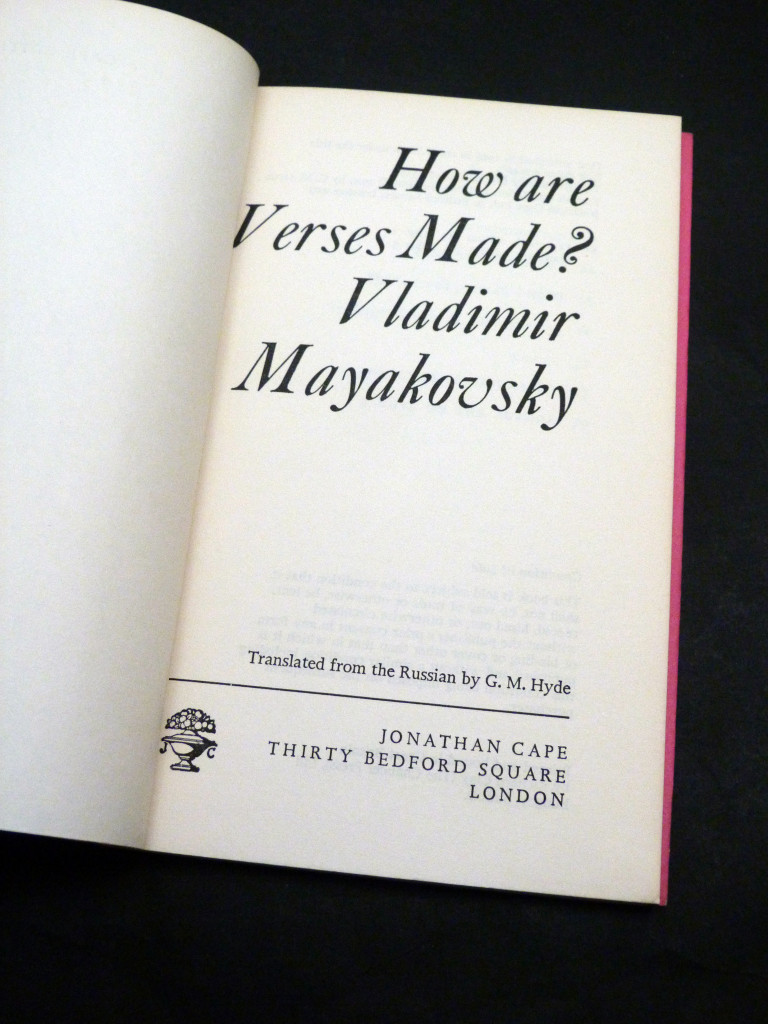
“ Art must not be concentrated in dead shrines called museums, It must be spread everywhere – on the streets, in the trams, factories, workshops, and in the workers homes. ” – Vladimir Mayakovsky
“Kak delat stikhi”, written in 1926, which translates as “How are verses made”, describes the process of poetic production in the works of Vladimir Mayakovsky. At the same time, Constructivists were engaged in the creation of an organised group debating the question of the means through which built forms were created; “How are buildings made.” Mayakovsky’s principles echo the idea of his contemporaries, who collectively formed the LEF (Left Front of the Arts). The organisation was led by Osip Brik, whose role as a critical theorist brought together diverse creative professionals. Mayakovsky’s role as founder-editor of the organisations served to guide the work of professionals within his realm of influence.
Alexander Malinovsky, also known as Bogdanov, has been known for his influence on Constructivism and the works of Mayakovsky, evident in the methodology for ‘proletarian creation’.
Bogdanov’s role as Lenin’s rival in the Bolshevik party contributed to developing the Bolshevik theory of future socialist culture. The distinctive approaches adopted differed in relation to the cultural legacy inherited in Revolutionary society owing to a ‘bourgeois’ past. He opposed Lenin’s reasoning that proletarian culture would develop due to experience accumulated under a capitalist regime. According to Bogdanov, a proletarian ascent would be independent of previous relations and the influence of political forces, instead reflecting socialist perception and practice. In addition, his role as an organiser of the “proletarian” culture movement “Proletkul” and associations with notable contemporaries such as Lunacharsky and Gorky influenced his career and public perception.
Under a capitalist regime, the physical and metaphysical aspects of the built environment were perceived as opposing factors and forces, unlike the socialist conception that strived to amalgamate the two.
Capitalist systems created a dualism of
- The material or “biological” nature of man’s existence, and
- the “spiritual life” existed as opposing principles within every culture.
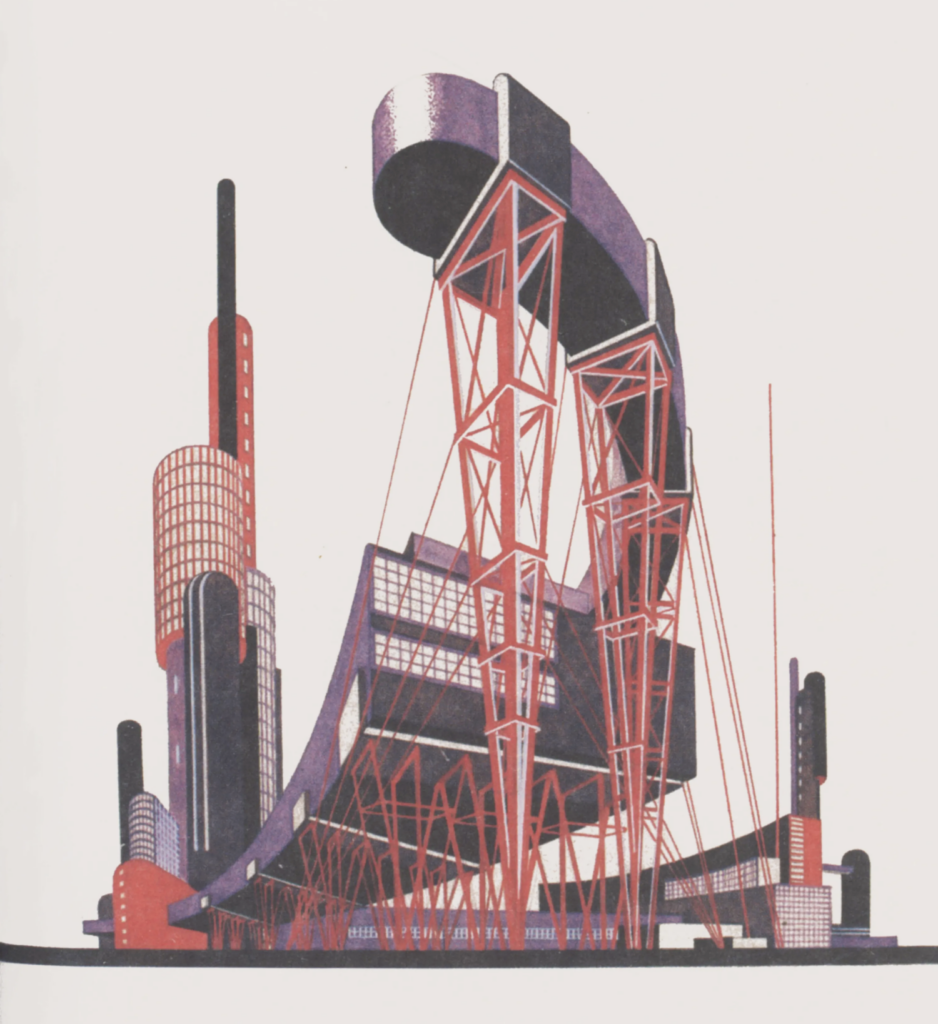
Structure
In Constructivist ideology, artistic practice and creativity were required to be governed by a methodological order rather than simply relying on intuitive understanding. Constructivism emphasises the role of intangible culture in forming tangible materiality. It encapsulated the assimilation of factors which led to the conception of the final architectural object in a linear process based on prioritising aspects of influence to proceed and obtain technical and formal precision logically. Furthermore, experimental research methods have contributed to the extensive body of knowledge comprising a research background. Constructivism has been described as an “exploratory and experimental” process based on assessment and inquiry. Laboratory investigations in subjects such as building science, sociology, visual psychology and the development of formal languages formed the focus of a pedagogical framework dedicated to creating new typologies, which would, in turn, give form to a new and alternate style of living.
Moving from one influential factor impacting the design process to another logically
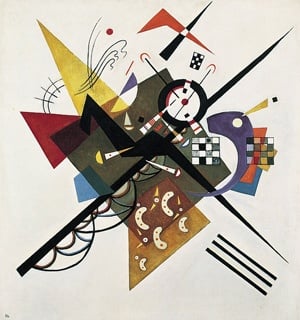
Wassily Kandinsky’s “On White II,” 1923, oil on canvas
In 1920, a group of artists based in Moscow at the art-research institute – Inkhuk were involved in the evolution of creative practices which juxtaposed the old artistic principle of “kompozitsiia” with their new thinking through the “konstruktsiia” to create a “Working group of Constructivists”. This integration was specifically facilitated through the institute, “Inkhuk”. The seven-member artists of the working group consisted of Alexei Gan, Alexander Rodchenko, and his wife Varvara Stepanova, who formed the original “initiative group”. With the brothers Georgi and Vladimir Stenberg, Konstantin Medunetsky and Karl Iogansen, the members of the Working Group embraced the science of konstruksiia through principles of organisation, with a declaration written by Alexei Gan. The work of the group was based on scientific communism and historical materialism. They focused on the synthesis of three basic concepts of “tektonika”, “konstruksiia”, and “faktura” bound together through an “organic link”.
Tektonica, derived from geology meaning the shifting of the earth’s plates, represents an “eruption of the inner essence”. Emerging from communism, the effective utilisation of industrial material and a departure from traditional artistic techniques.
Faktura, is indicative of the process by means of which raw material is processed for use in construction. It represents the organic form of material that enables the operation of tektonica and konstruktsiia.
Konstruktsiia represents the process of design and assemblage within the discipline of Constructivism.
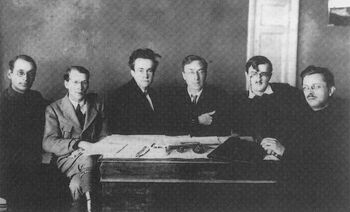
Inkhuk – The Working group of Constructivists comprising Alexei Gan, Alexander Rodchenko, Varvara Stepanova, Georgi and Vladimir Stenberg, Konstantin Medunetsky, Karl Iogansen
Industrial art, sculpture and architecture
By 1921, the group comprising “twenty-five leftist artists” in Inkhuk dedicated their efforts towards artistic production (khudozhestvennoe proizvodstvo) as opposed to the older conceptions of art (iskusstvo) that dealt primarily with the notion of fine or pure art (izobrazitelnoe, chistoe or stankovoe). Influenced by highly theoretical colleagues in the circle around Osip Brik, the group’s focus shifted from art towards the artefact, which reflected an intention to embrace the constructed, manufactured form created due to political forces absent in nature.
Constructivist artists like Alexei Gan and Alexander Rodchenko created the profile of the “artist-constructor” who was closer in definition to the “khudozhnik-konstruktor” – an artist-designer or an artist-engineer rather than a “khudozhnik-stroitel” – an artist-builder. They aspired to produce artist-designers through their curricula in the Vkhutemas. The title “konstructor” bore negative connotations compared to the term “designer”, referring to a stylist. At the same time, the former implied the artist’s role in conjunction with the designer and the builder, creating a holistic understanding of the discipline and practice.
The integration of the physical and cognitive processes defined the Soviet architects’ methodology characterised by a “functional creativity”, also referred to asthe “method of functional thinking” or their “functional method”.procedureology represented the integration of material and cognitive processes the in design, integrating the tangible and the intangible aspects of material culture. According to Bogdanov, the work of the “architect-constructivists” was required to demonstrate this holistic monism representing architectural systems as he endeavoured to “construct” new identities in both disciplines.
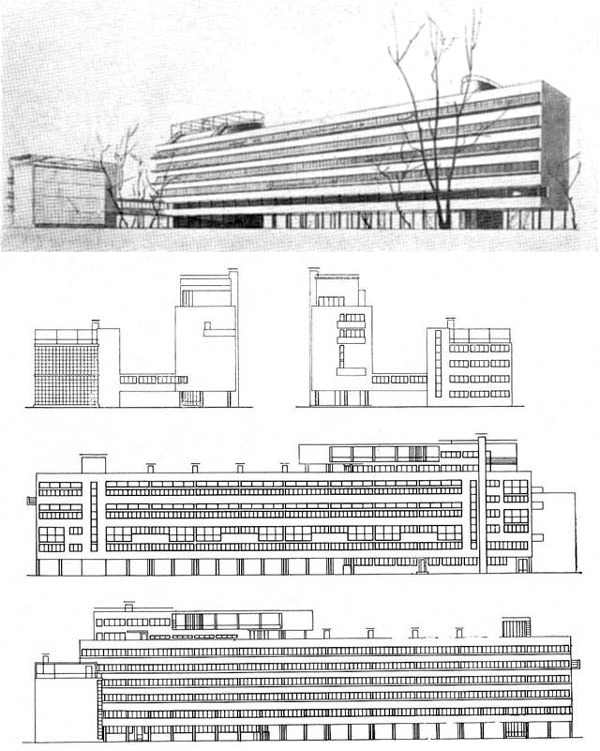
The Narkomfin Building