A Senagalese Modernism
Architectural solutions that address political discordance
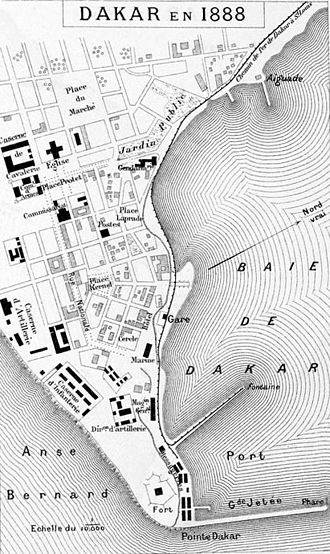
Dakar in 1888, New york Public Library from Le Senegal la France dans l’Afrique occidentale, louis Faidherbe
The late nineteenth and early twentieth century established and defined the French influence across West Africa. The process primarily concentrated on the four coastal towns of Dakar, Goree, Rufisque and Saint-Loius. Saint Louis was the first French colonial capital in West Africa after which the capital moved to Dakar. Dakar’s strategic position rendered the city appropriate for developing and implementing policy related to colonial organization. In an effort to unify the French empire, the “Assimilation Policy” was formulated which however, resulted in adversely affecting an existing diversity within the range of cultural identities. In particular, it divided the African region into colonial and indigenous centres which since its inception have influenced the development of African society, education and cultural practice. The policy disregarded the prevalence of a local value system seeking to transform the landscape through the introduction of French values. In addition, it offered French citizenship to the residents of the four coastal towns or original communes, who acquired an elitist status as a result.
Shifts in governance mechanisms over French colonial territory was reflected in urban footprint and territorial distinctions. In Dakar, the city was segregated into colonial and local enclaves. Le Plateau formed the central urban core housing colonial employees and serving as an exemplar of French cultural influence while the Medina, or the old city quarter formed the enclosure defined and occupied by the local population. The segregation was enforced to contain the bubonic plague that had affected significant sections of the population in 1914. However, this distinction between politically distinct sections of population and territory, not dissimilar to the creation of black and white towns in colonial empires across the world, established a lasting trend that distanced the African neighborhoods from the central urban core in Dakar. The representation of the Africans in the military and administrative services sought to promote recognition to significant sections of the African population in the French Assembly and Army in an effort to acquire French citizenship.
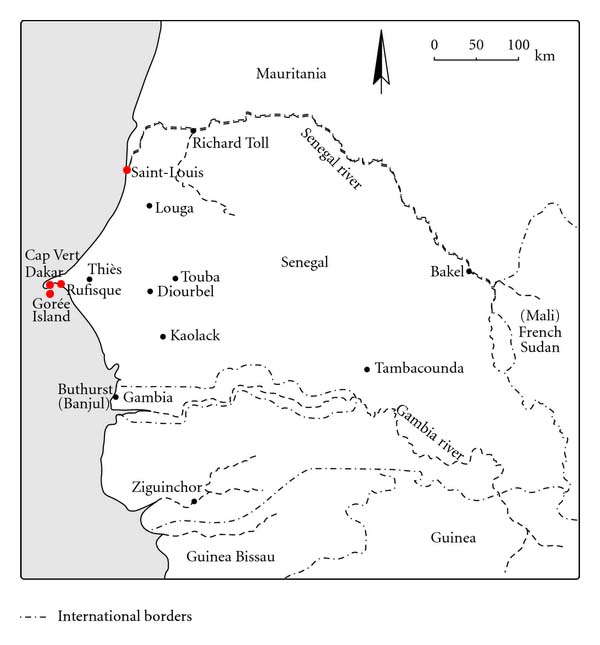
The misinterpretation and socio-cultural disarray that characterized the French colonies invited a re-examination of the root cause. A revision of past policy decisions of assimilation resulted in a growth of several initiatives that sought to reconcile differences and diminish a pronounced socio-economic segregation. President Senghor sought to accomplish this through the textile industry, music and architecture. In addition, cultural events such as the Saint Louis Jazz Festival and the DakArt Biennale brought Senegal to the forefront of art and culture in the 1960s and 1970s. Through the dissolution of differences and French and African cultural integration, President Senghor endeavored to articulate a Francophilic reception of values and tradition in the African context.
The French influence in Africa and its cultural integration is enshrined in the permanence of architecture and the built environment. In particular, it is evident most prominently in the climatic adaptation of modernist forms of building which were introduced to the African colonial context. By employing methods distinct to an African locale, a modernist architectural language developed and was represented through a series of distinct forms that expressed an “asymmetrical parallelism”. The development of this ideology can be attributed to President Senghor’s own interest and engagement with music and poetry. The concept has beendefined by Senghor as “a diversified repetition of rhythm in time and space”[1]– an architecture composed of similar volumes and spaces that do not repeat. The development of a Senegalese Modernism based on asymmetrical parallelism and the reinterpretation of the building envelope signified a departure from more traditional techniques employed within Tropical modernist architectural practice, such as the use and incorporation of the brise-soleil, thereby assigning a distinct identity of Franco-African cultural cohesion.
Architecture and Governance, Dakar
Early Modernism
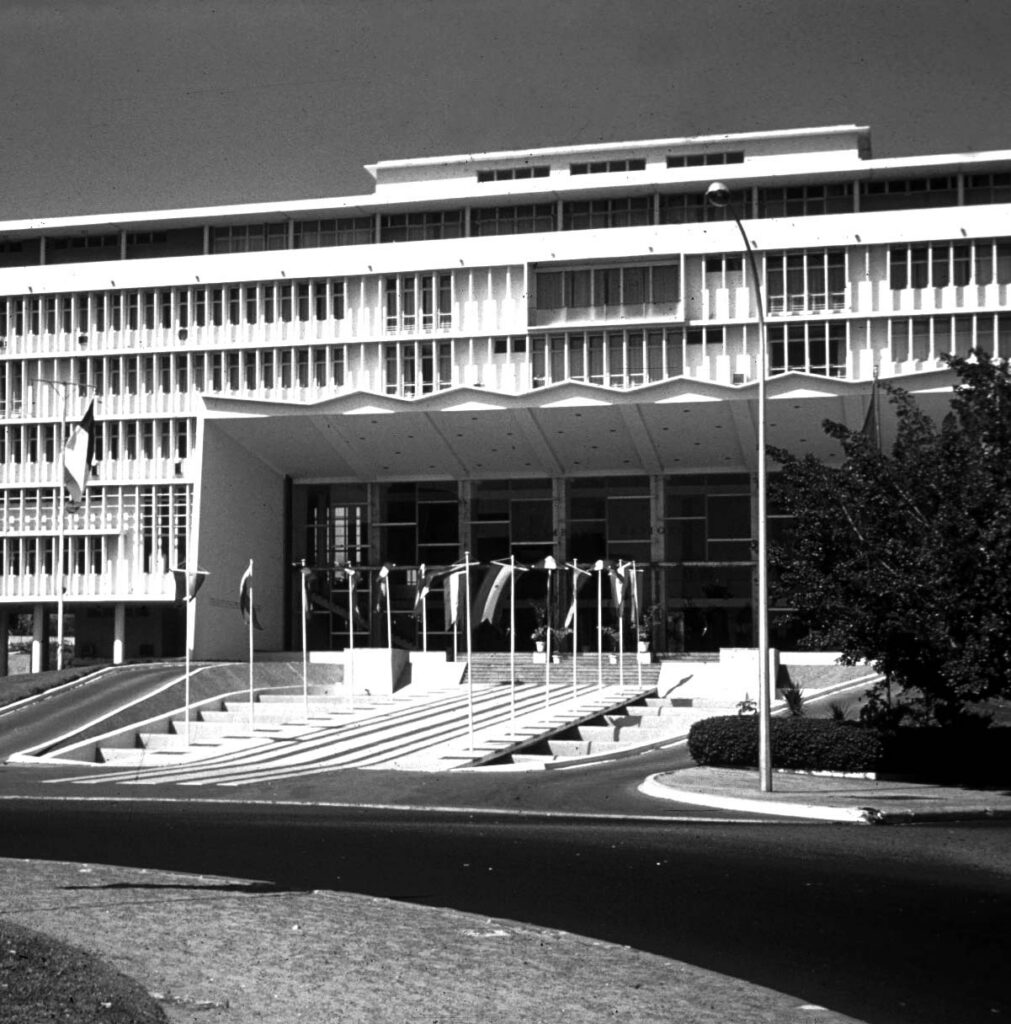
The National Assembly (1952-1956)
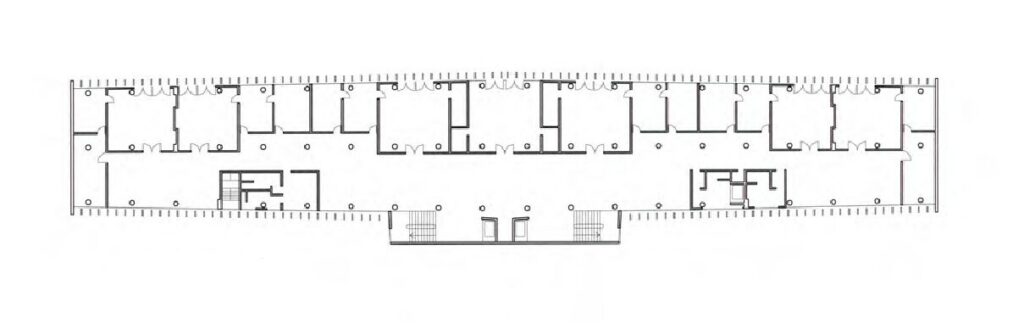
The main building of the National Assembly in Dakar is characterized by a wide facade that forms the western edge of the Place Soweto. The building envelope has been designed by incorporating louvers that facilitate cross ventilation across the narrow slab of offices and selectively permit the entry of light. In addition, the setback of windows from the façade provide shade and create balconies that punctuate the monolithic surface.
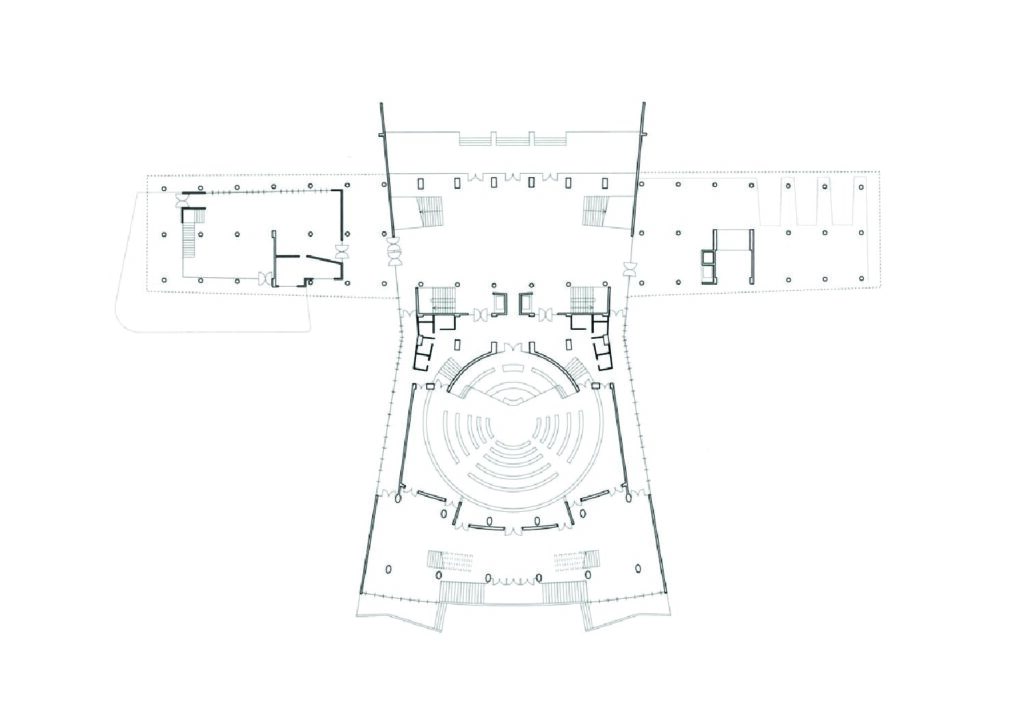
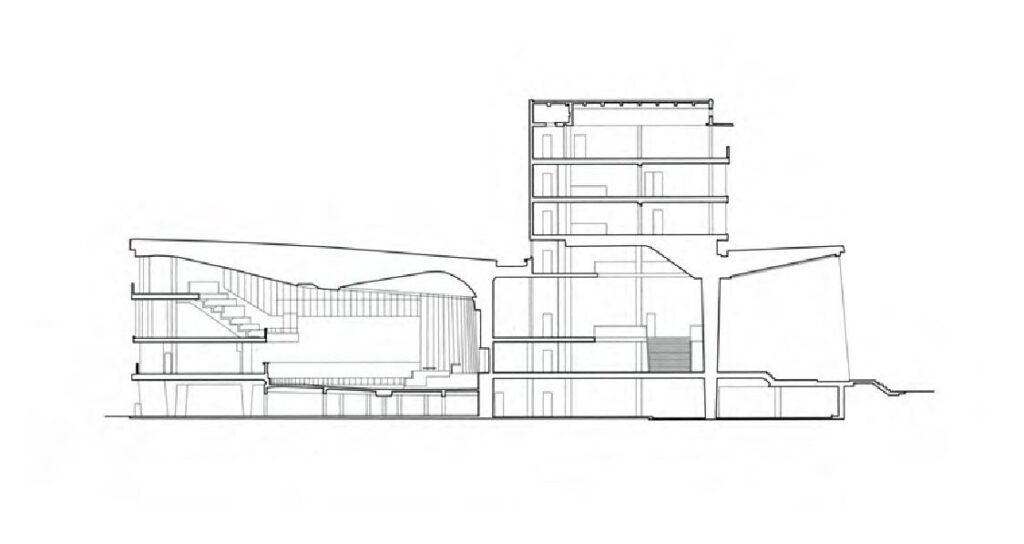
The Office block is intersected by the Assembly block, a form and volume similar to the former, yet distinctly articulated to express an alternative existence inherent to and inseparable from it. The second volume defines the alternate axis and forms the approach into the interior of the building. The two volumes are supported by a grid of columns that further reinforce a rhythmic identity but are introduced into the interior as opposed to the rhythmic layered façade external to the core.
The Assembly Hall is significant both in terms of form and function. As an administrative forum, it represents a space for political debate and discourse seeking to define a national identity. Additionally, being modeled on the French Assembly and constructed of paneled timber, it articulates the public and political temperament of the period that sought to create a future influenced by the past, and yet distinct from it.
Building Communal
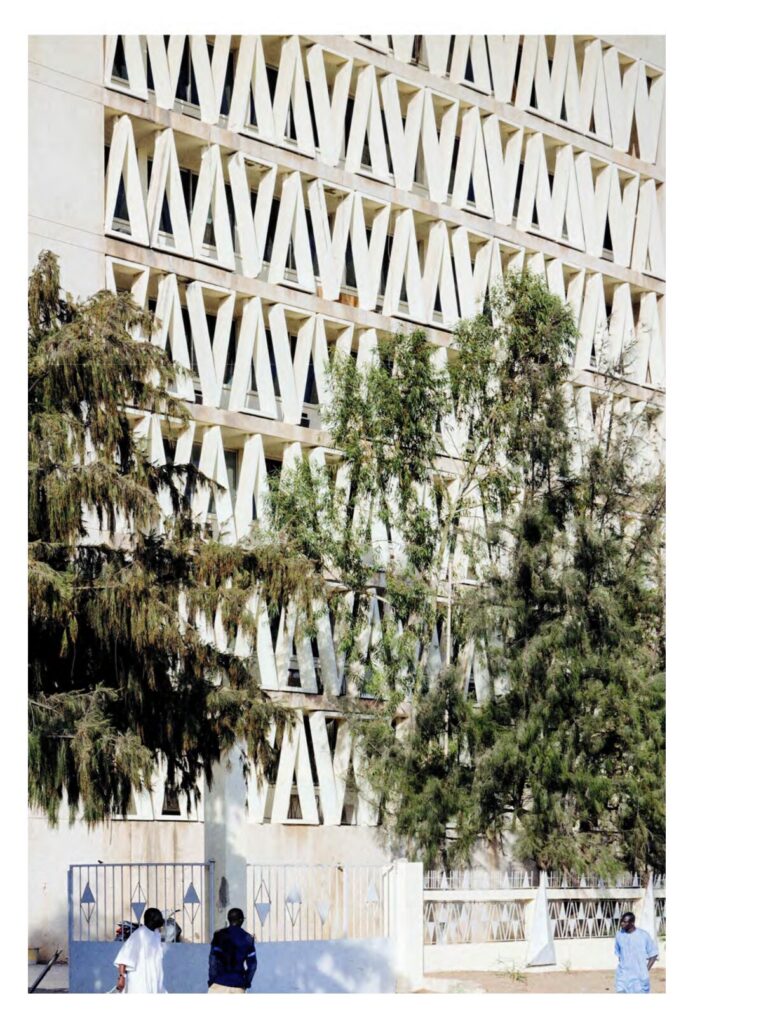
The building envelope of this structure is composed of layers of triangular louvers that articulates the intent of an earlier modernist period of the 1950s, through principles of natural ventilation and shading.
Late Modernism (and remnants of the earlier style)
Ministry of the Interior (~1960-1970)
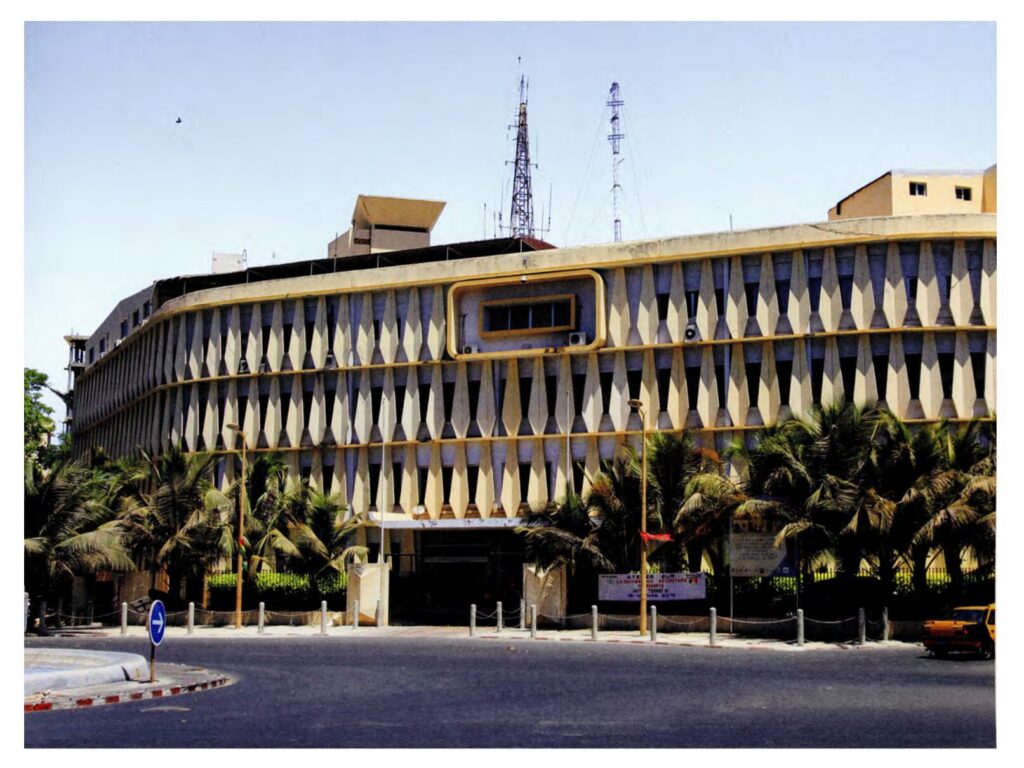
The Ministry building is especially prominent as a result of its distinctive façade. The recladding of the building sought to represent a collective understanding of the architectural principles during the late Modern period that emerged as a redefinition of pre-colonial Modernist ideas. Subtle adaptations evident in the architecture of the 1960s and 1970s were evident in the revisions made to louvered façade and the overall form. The Ministry building reflected this transition through the reinterpretation of louvers into thin precast elements applied as shading devices across the façade.
Foire Internationale De Dakar (1974)
Lamoureux, Marin and Bonamy
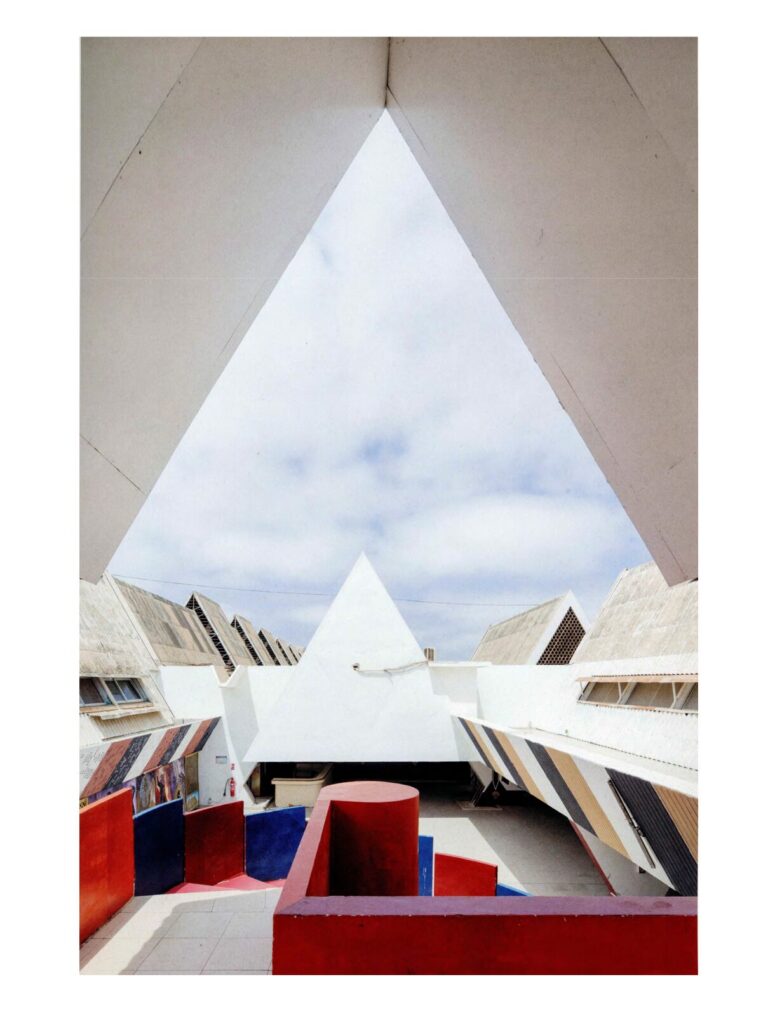
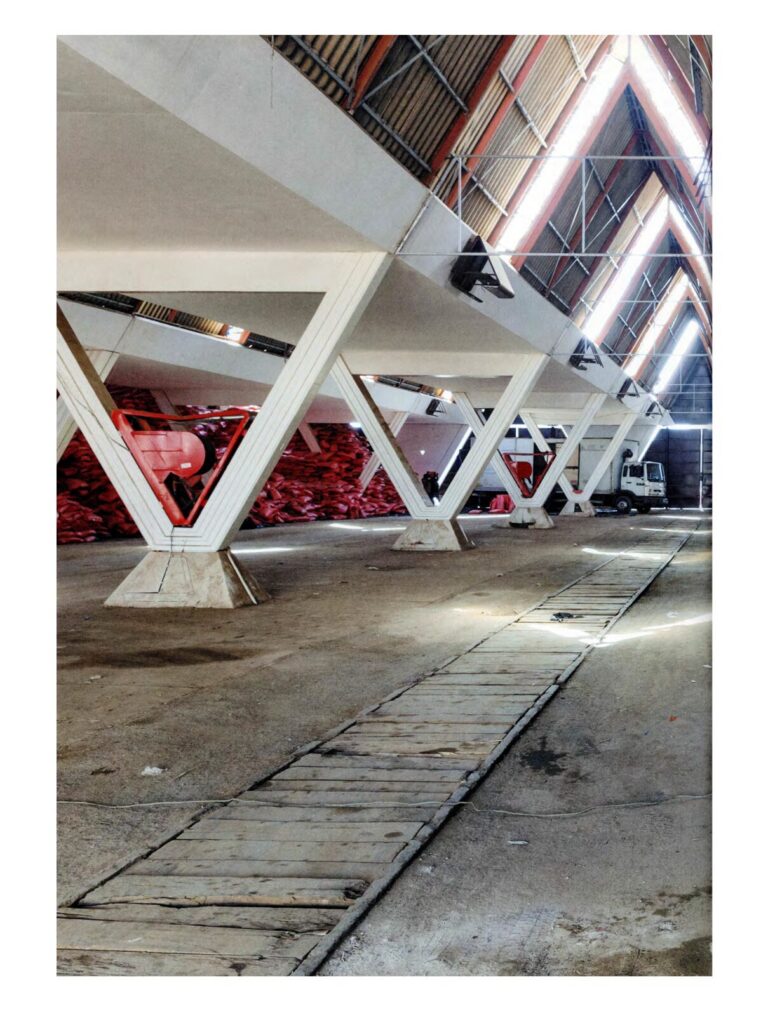
The building was designed to house the city’s International Trade Fair through a collection of pavilions and exhibition halls. These structures are located radially at the end of the access route to create a series of courtyards that serve to function as open exhibition spaces. The design aptly articulates the concept of “asymmetrical parallelism” through its repetitive use of multi-scalar triangular roof structures. The flexibility of the form enables it to be used for a variety of functions. On a larger scale, the triangular roof is used to enclose an extensive warehouse. On a smaller scale, the triangles are inverted to contain offices and meeting rooms. For the exhibition halls, the triangles supports a light suspended roof that is manipulated to increase the porosity. The roof and the base are joined through the incorporation of triangular gutters that run along the length of the structure defining the junction between the upright and inverted triangular forms. These subtle adaptations in scale and details such as the offsetting of the roof diffuses light and provides opportunities for natural ventilation.
Universite Gaston Berger UGB St. Louis
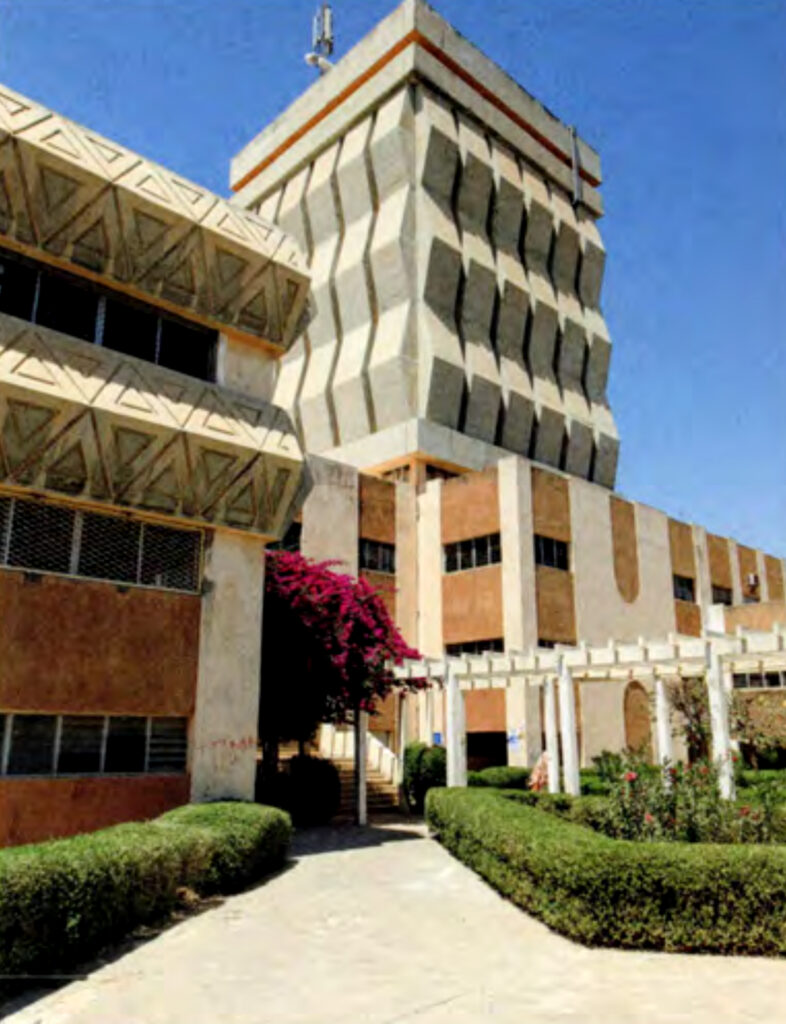
Senegal’s second university was established in 1975. The tower contains the library, and the environmentally controlled interiors are shaded, ventilated and well-lit to accommodate reading spaces and storage space for books. Student Accommodation called ‘villages’ are grouped around the main university building in the form of residential settlements. They employ an aesthetic that refers to the mud structures of the Sahel. The articulation of the façade and creation of shading devices are unique to this project and manifest in the form of extended wings of the building’s gable ends. The residential clustering of the units demonstrates multiplicity and repetition of shading devices and elements that employ the founding principles of the Senegalese Modernist style.
Hotel Independence (1973-1978)
BEHC Henri Chomette with R. Depret and T. Melot
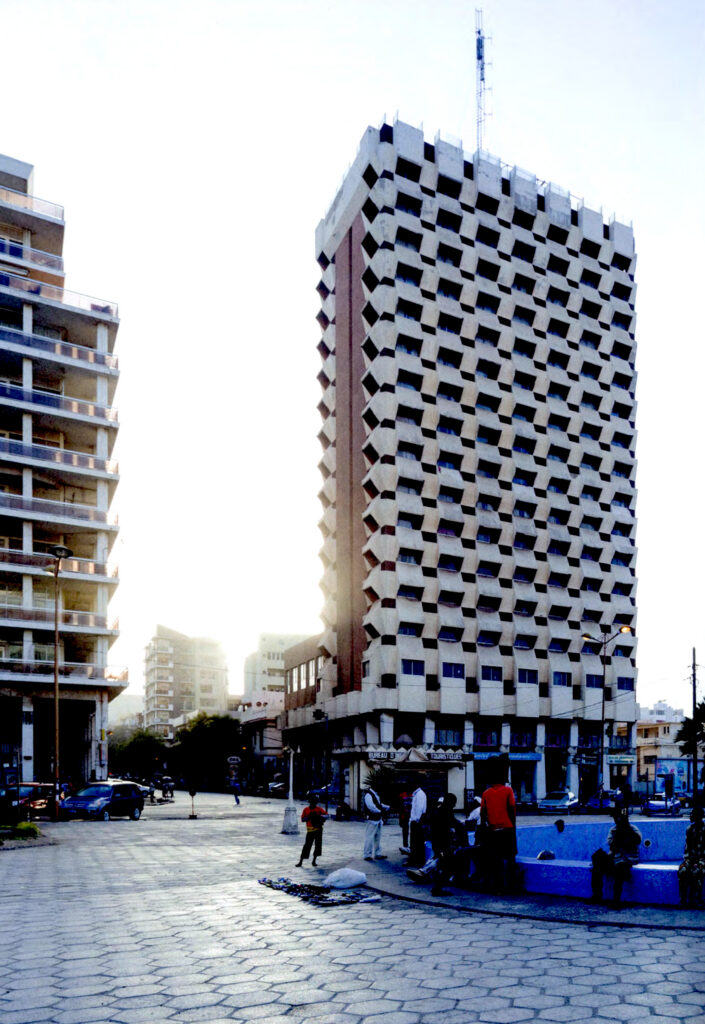
The building exemplifies a cultural response during the 1970s before the large-scale adoption of glazing that defined commercial towers in the following decade. The hooded windows are distributed generously across the façade creating an impression of scales that function as shading devices and facilitate cross-ventilation. The project exemplifies one of many forms that sought to construct an identity of the ceremonial space of the city through the redefinition of the façade from the traditional bris-soleil of the 1950s. It represents the synthesis of western African indigenous building traditions and Senghor’s building policy of asymmetrical parallelism.
The Assembly, the Trade Fair, The University and the Hotel were among the building typologies that adopted and further articulated a developing language of Senegalese Modernism and the State. The hotel, remaining peripheral to this ensemble, nevertheless participated in demonstrating the significance placed on cultural tourism with respect to the political and economic stability of Senegal.
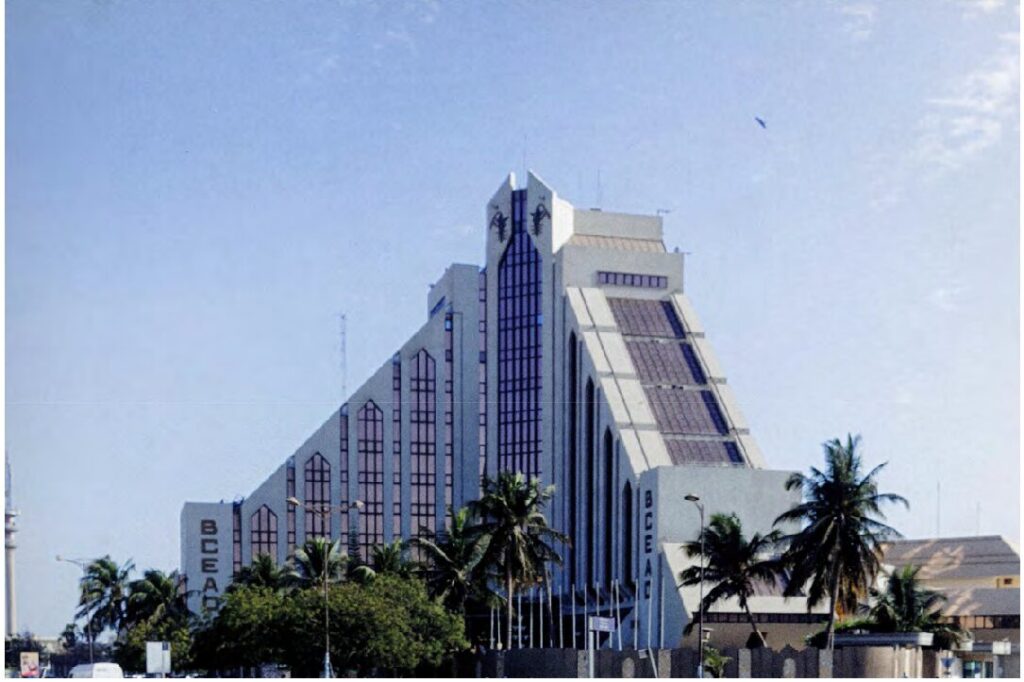
The Central Bank of the West African Economic and Monetary Union (1975 – 1990)
The building houses the offices of the Senegalese National Branch and constitutes a set of institutional buildings and is located on territory that initially belonged to the sanitary belt established in 1914 in an effort to contain the bubonic plaque.
Situated on the edge of the Medina the building functions as a counterpoint to the main headquarters of the bank located in Le plateau. Presumably built by Senegalese architects Cheikh N’Gom and Pierre Goudiably Atepa, the form integrates two main structures. The first is represented through a tapering tower defining the east-west axis. It directs traffic towards the north-east and defines the west by means of a pyramidical façade. In addition, the tower offers a reinterpretation of the porous façade through the extensive incorporation of reflective glazing.
The second, a more substantial mass reflects the earlier modernist period of the city’s architecture, and stands in contrast to the tower that exemplifies a lighter structure articulating a late modernist environmental response through the incorporation of a glazed exterior.
Centre D’Affaires (1977-1981)
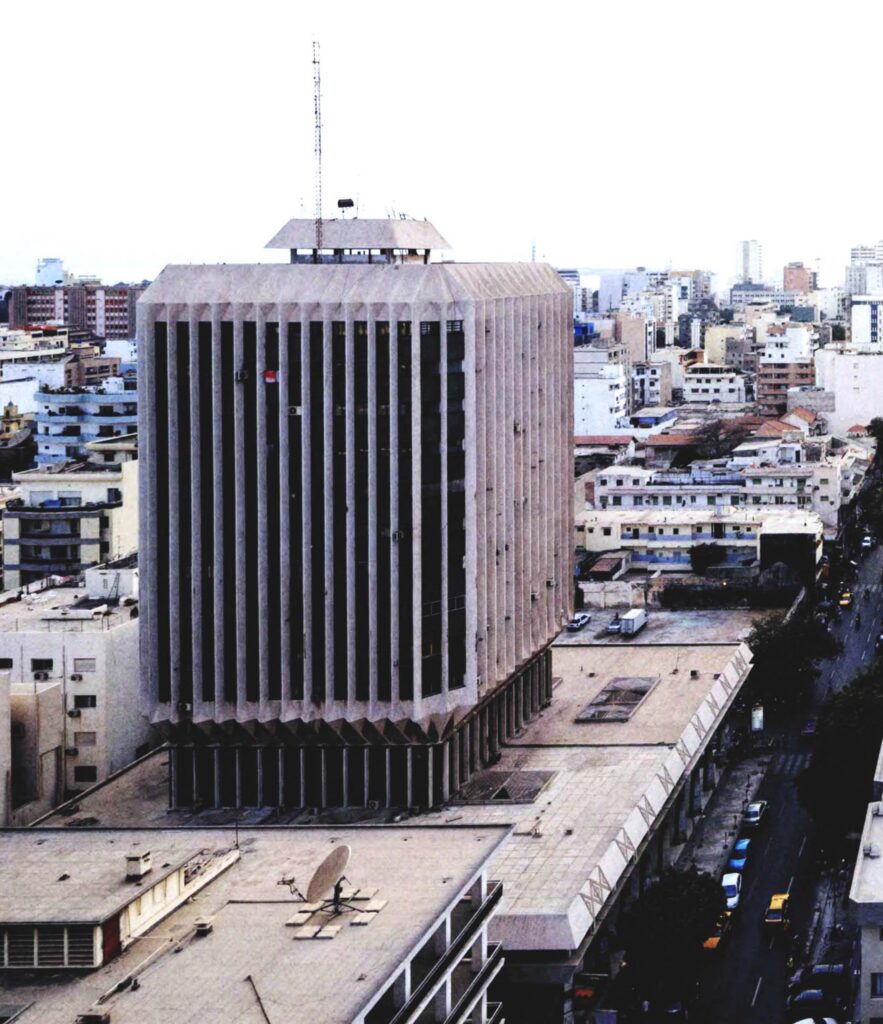
BEHC Henri Chomette with Roland Depret (presumed)
The building, similar to the Central Bank, is composed of two distinct parts – the base and the tower where the latter manifests as an extruded version of the former. The tower houses commercial functions and is defined externally by means of thin fins. The base exemplifies an attempt at incorporating ground level commercial functions within the interior with an open plan lobby space. However, as directed by the context, the commercial functions at the street level remain concentrated in the markets external to the enclosure.
The projects discussed demonstrate a historical trajectory that articulates the adoption of a European Modernism and its synthesis with African identity through the concepts of asymmetrical parallelism and the evolving definition of a climatically responsive building envelope. Furthermore, the projects seek to demonstrate subtle changes within the aforementioned overarching design methodologies that translated industrial and post-industrial processes through the large-scale adoption of reflective glazing. These distinct approaches have contributed to a Senegalese Modernism that serves as an exemplar for cultural cohesion made possible through architecture, a feat that planning policy and mechanisms of governance had previously been unsuccessful at.
Notes
[1] www.senseatlas.com/territory/the-international-fair-of-dakar/